

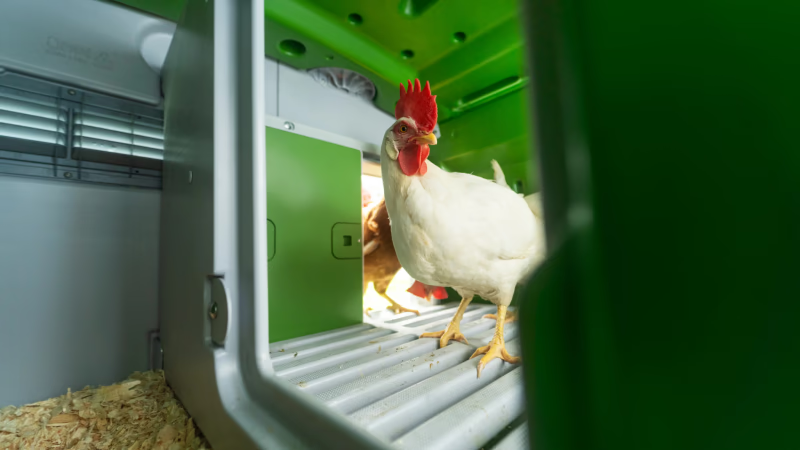
Omlet designs smart products for pet owners, including automated chicken coop doors and connected monitoring systems. They needed real-time AI object detection running on battery-powered cameras with no mains power and limited connectivity, a setup that rules out both cloud processing and standard GPU hardware. New Gradient developed an edge AI deployment with a carefully selected neural network architecture, aggressive optimisation, and intelligent inference scheduling, delivering real-time detection and instant mobile alerts on ultra-low-power devices.
Real-time detection without mains power or cloud connectivity
Omlet wanted to offer customers a smart monitoring system for chicken coops: verify the flock's safety remotely and receive alerts when chickens haven't returned to the coop at night. The fundamental constraint was running sophisticated object detection on a battery-powered camera in a garden shed with no mains power and limited connectivity.
Cloud processing demands constant connectivity and introduces latency. Powerful local hardware drains batteries in hours. The system needed to run continuously on minimal power while maintaining accurate detection in challenging outdoor conditions: variable lighting, weather exposure, and subjects that move unpredictably.
Architecture selection, quantisation, and adaptive inference
Rather than simply shrinking a standard detection model, we selected a lightweight neural network architecture suited to the specific constraints of battery-powered edge inference, then optimised it aggressively for power efficiency through careful selection of operations and layer structures that maximise accuracy per watt consumed.
The training process incorporated the specific challenges of the deployment environment. We collected and annotated thousands of images covering the full range of conditions: dawn and dusk lighting, varying weather, partial occlusions, and multiple chickens in frame simultaneously. The resulting model achieves robust detection across these scenarios while fitting within the tight computational budget of battery-powered edge hardware.
Quantisation, pruning, and efficient inference scheduling keep power draw to a minimum. The system intelligently manages when to run inference, balancing responsiveness with battery life. When chickens are detected in the run area at dusk, monitoring frequency increases; during quiet periods, it scales back to conserve power.
Real-time detection and instant alerts on battery power
The deployed system delivers real-time chicken detection and counting on battery-powered IP cameras, enabling Omlet to offer a genuinely useful smart coop product. Users receive instant mobile notifications when chickens haven't returned to the coop, along with accurate counts of birds in different areas. The system operates for extended periods on battery power alone, making it practical for garden installations without mains electricity.
The model maintains accuracy across lighting conditions from bright daylight to the low-light periods when monitoring matters most, as chickens return to roost at dusk. Chickens are variable in appearance and behaviour, and outdoor conditions change constantly. Domain-specific training on exactly these scenarios delivers reliable detection where generic pretrained models would fail.