

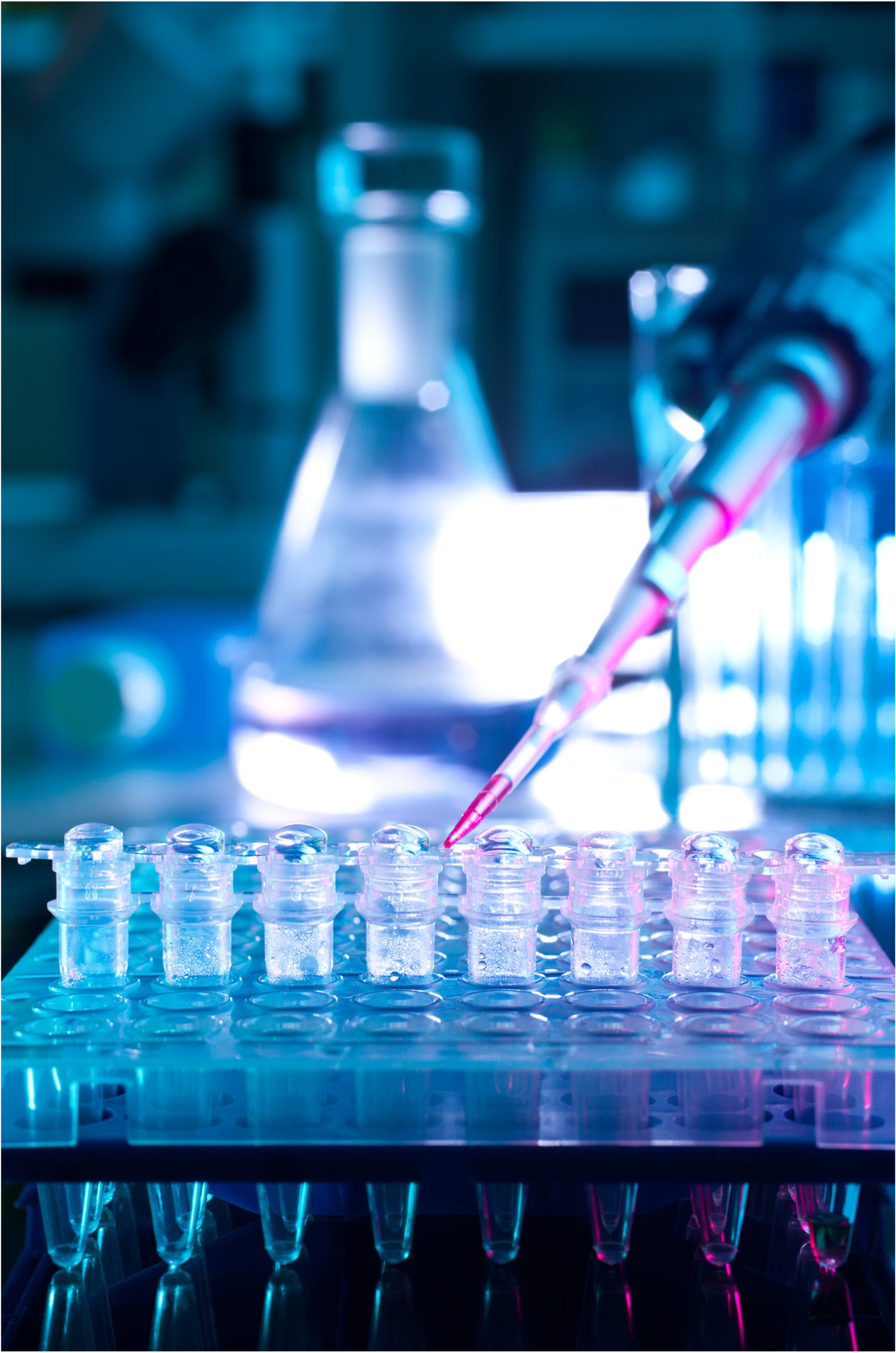
Origin Peptides is developing the world's only truly solvent-free approach to peptide synthesis. Their production process depends on precise control of reaction conditions across dozens of variables. New Gradient built machine learning systems to optimise peptide production in real time, predicting which peptides will synthesise successfully and automatically adjusting conditions throughout manufacturing.
Toxic solvents and unsustainable production
Peptide therapeutics are among the most important medicines available today, yet their manufacture carries significant environmental and financial costs. Current production methods rely on toxic solvents, protected amino acids, and inefficient stepwise processes, generating millions of kilograms of hazardous waste annually. The world's largest peptide manufacturer alone produces over 15.1 million kilograms of hazardous waste each year.
With demand for peptide-based treatments surging dramatically due to GLP-1 therapies like Ozempic and Mounjaro, the pharmaceutical industry faces an urgent challenge. Scaling production using existing methods would multiply an already unsustainable environmental footprint. The sector needs a fundamentally different approach, one that can meet growing demand while eliminating the toxic byproducts that define conventional peptide synthesis.
Predictive modelling and real-time process optimisation
Our collaboration with Origin Peptides began with predictive modelling to identify which peptides would synthesise successfully using their novel aqueous templated process, the only truly solvent-free peptide synthesis method. We engineered over 150 descriptors per peptide, incorporating chemical properties, sequence patterns, and structural characteristics derived from AlphaFold protein structure predictions. Deploying optimised XGBoost models, we improved experimental planning and resource allocation from the outset.
This foundational work contributed to securing a £6.4 million award from Innovate UK's Sustainable Medicines Manufacturing Innovation Programme (SMIP), in partnership with Origin Peptides, the Centre for Process Innovation, and Queen Mary University London. The programme is now scaling aqueous peptide synthesis to commercial production levels.
New Gradient is leading AI and software development for the programme. We are building specialised machine learning systems for real-time process optimisation, analysing data as peptides are synthesised and automatically adjusting production conditions throughout the manufacturing run. Using model predictive control and frontier neural network architectures, our models must generalise across diverse peptides and operating conditions with limited training data, optimising both initial parameters and continuous adjustments throughout synthesis.
6x faster production with zero toxic waste
The combination of Origin Peptides' aqueous process and our real-time ML optimisation achieves 6x faster production compared to conventional methods, generating zero toxic waste. In an industry where the largest manufacturer alone produces over 15.1 million kilograms of hazardous waste each year, eliminating solvents entirely while increasing speed represents a step change in how peptide therapeutics can be manufactured.
The platform incorporates live QA/QC capabilities with in-line sampling feeding directly into our ML optimisation software. This closed-loop approach, a first for peptide manufacturing, allows the system to learn and adapt throughout each production run rather than relying on post-hoc batch analysis.
Backed by £6.4 million in Innovate UK funding, the programme is now scaling aqueous peptide synthesis toward commercial deployment. The ML systems must handle new peptide sequences, varying batch sizes, and evolving process conditions, each run generating data that improves the next.