

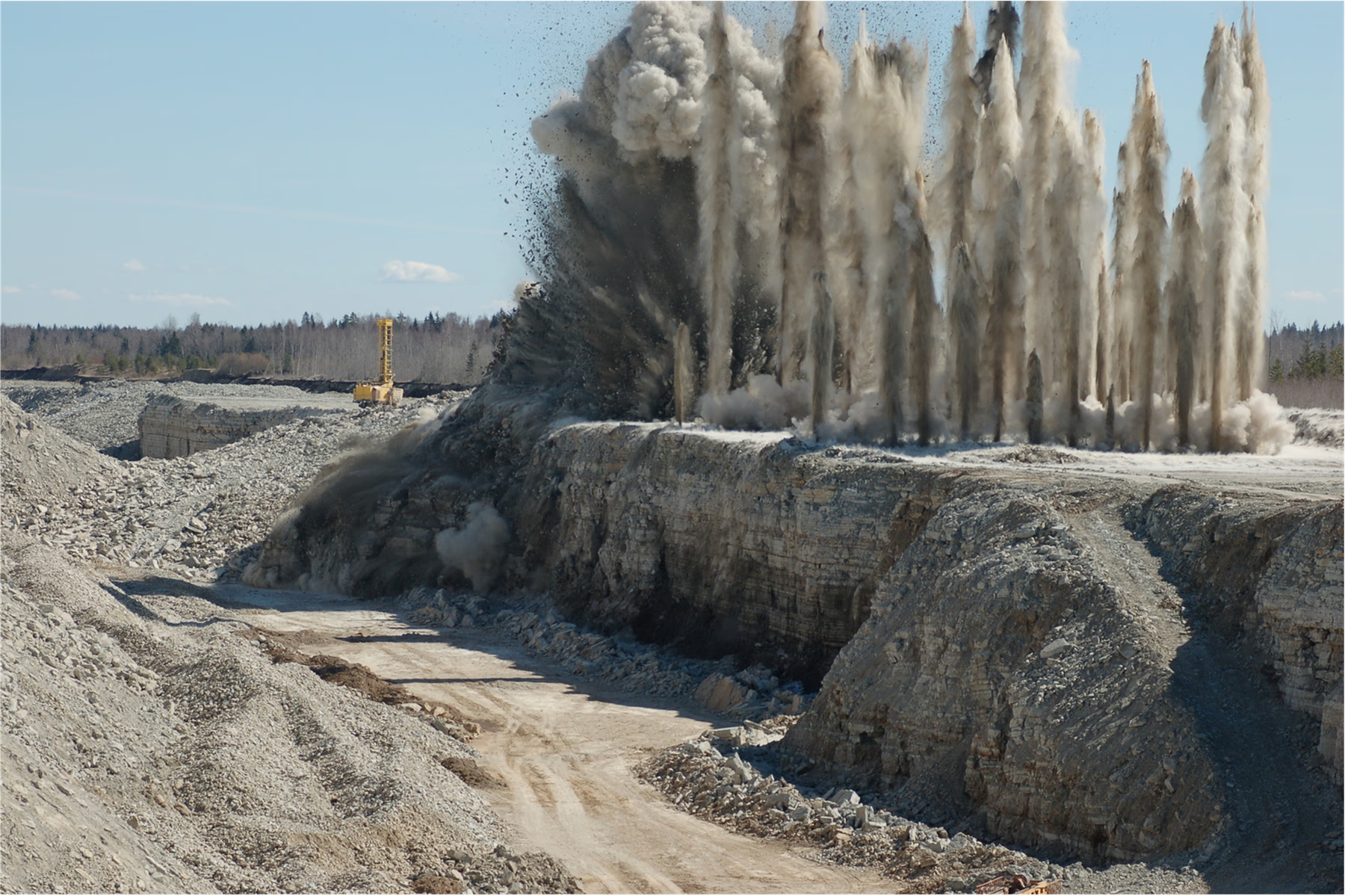
Tarmac is the UK's leading sustainable building materials company, operating quarries where blast design directly determines fragmentation quality, processing efficiency, and CO2 emissions. Achieving the ideal rock size distribution from each blast reduces secondary breaking, energy consumption, and cost per tonne. New Gradient developed an AI quarry blast optimisation system combining edge-deployed computer vision with predictive machine learning, delivering a 21% reduction in CO2 and 6% cost savings.
Fragmentation variability and the cost of reactive blast design
Hard rock quarries face a complex optimisation problem at the heart of their operations. The goal is to achieve an ideal rock size distribution from each blast, large enough to avoid excessive crusher wear, small enough to minimise secondary breaking requirements, and consistent enough to maintain efficient processing throughput. Getting this wrong is expensive: oversized rock requires additional breaking, undersized material clogs equipment, and inconsistent fragmentation creates unpredictable downstream costs.
Traditionally, blast design relied heavily on operator experience and rules of thumb. Explosive weights, hole patterns, and timing sequences were set based on geological assumptions that couldn't account for the natural variation in rock face conditions. Without real-time feedback on blast outcomes, optimisation was slow and reactive. Adjustments came only after problems manifested in processing costs.
Edge computer vision and predictive ML for blast design
Working with Tarmac, the UK's leading sustainable building materials company, we developed an integrated AI system that closes the loop between blast outcomes and blast design. The solution combines edge-deployed computer vision with predictive machine learning to enable continuous process optimisation.
Our computer vision models analyse drone imagery of blast piles, automatically measuring rock size distribution across thousands of fragments in real time. Running on edge hardware at the quarry site, the system provides immediate feedback without requiring cloud connectivity, essential for remote operational environments. This transforms fragmentation assessment from periodic manual sampling to comprehensive automated analysis of every blast.
The fragmentation data feeds a machine learning model that predicts blast outcomes based on input parameters and geological conditions. By learning from historical results, the system identifies optimal blast patterns for specific rock face characteristics, balancing explosive costs against downstream processing efficiency. The model accounts for complex interactions between hole spacing, charge weight, timing delays, and rock properties that would be impossible to optimise manually.
21% CO2 reduction with 25% less secondary breaking
The system delivers measurable operational improvements: a 25% reduction in secondary breaking requirements, 18% lower energy consumption in crushing operations, and significantly more consistent fragmentation across variable geological conditions. These efficiency gains translate directly to reduced operating costs and lower carbon intensity per tonne of aggregate produced.
This work contributed to Tarmac's victory in the Institute of Quarrying's Emerald Challenge, a prestigious industry competition recognising innovation in sustainable quarrying practices. The award validated not just the technical achievement, but the broader potential for AI-driven optimisation to transform heavy industry operations.
The edge deployment architecture has proven robust across multiple quarry sites, demonstrating that advanced AI can operate reliably in demanding industrial environments. This project established a template for deploying computer vision and machine learning in process industries where real-time feedback and autonomous operation are essential requirements.